Chemistry in Build A Football Team
Position first, then nation / league / club tags. Green and blue win. Grey loses cups.
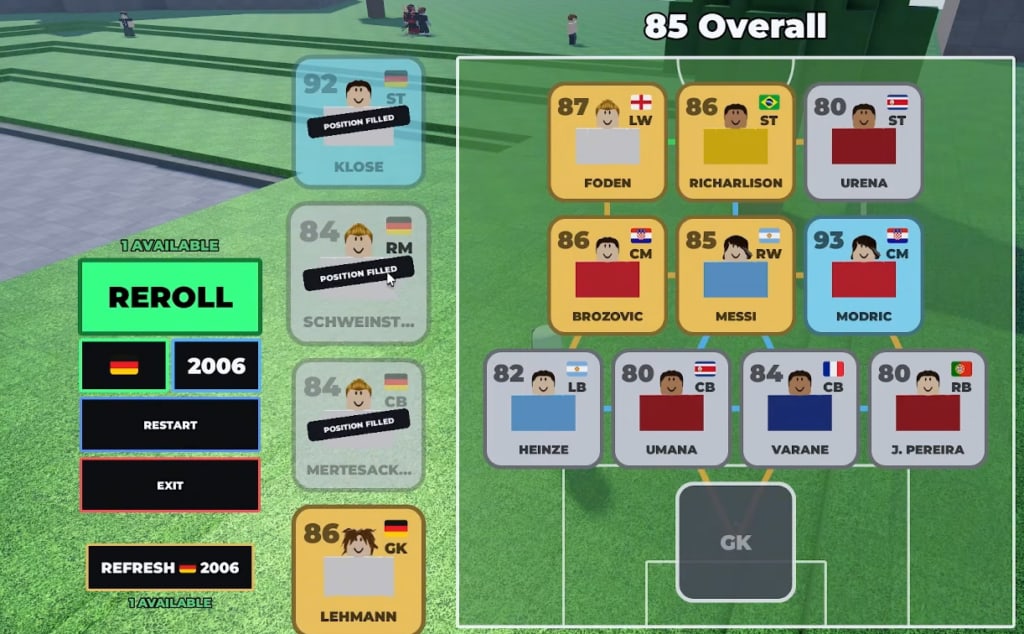
Chemistry is the hidden half of Squad OVR in Build A Football Team. Raw ratings average across the 4-3-3. Chemistry adds on top when neighboring cards belong together. A linked 90 clears doors that a mixed 96 cannot. Cup Mode asks for 93 OVR with chemistry included, so this page is not optional flavor — it is the difference between a locked portal and a tournament. If you still need the roll loop, read how to play first. If you have not even filled eleven slots, start at Getting Started.
Lines paint between neighbors on the pitch. You are not linking the whole club to every other club. You are linking ST to the CMs under him, LW to the left CM and the ST, LB to the nearest CB, and so on. Plan in pairs and triangles, not in a spreadsheet of eleven identical nations unless you actually own that nation.
Position first, then nation, league, and club
The first chemistry rule is natural position. A card has a printed role. Park it there. The 4-3-3 slots are LW, ST, RW, three CMs, LB, two CBs, RB, and GK. A centre-back at right-back is not “close enough.” The line out of that slot drops, and the squad number drops with it. If you only remember one sentence from this guide, remember that one.
Secondary positions exist so a linked card can stay on the pitch when its primary hole is taken. A CM who lists RB as a second role can hold the right side without fully greying the link, which is how you keep a nation pair together while you hunt a true RB. Secondary is a bridge. It is not permission to start a striker in goal.
After position, neighbors share tags. The three that matter are nation, league, and club:
- Nation — two Brazil cards next to each other, two USA cards, two Norway cards. This is the easiest green you can force, and it is why finishing one 2026 set for a captain also builds a chemistry core.
- League — two cards that play in the same domestic competition. Use this to stitch different nations together along a row. A mixed front three can still glow if they share a league tag.
- Club — the same club tag on adjacent cards. Club links are dense when they hit, and they are rare in a random roll. Keep them when they appear; do not Reroll a club pair to chase two extra OVR.
Tags only count between neighbors. A matching nation on LW and RB does nothing if the cards in between are a different soup. Build along the spine: GK into the back line, back line into the CMs, CMs into the front three. The team planner is a paper 4-3-3 for this exact sketch. Draw the tags before you spend a Refresh.
Captains help because a 99 OVR nation captain arrives pre-tagged for that country. Dropping that card in its real slot often turns two grey lines blue in one move. That is why the captains guide tells you to finish one grid instead of eight. Prime cards from the Hourly Shop are 100+ OVR, but a Prime in the wrong slot is still a grey line with a pretty number. Cup standouts at 105+ follow the same rule.
Line colors, keepers, and the mistakes that stall 93
Lines color by strength. Green and blue are the ones you want. Grey is the worst. Community testers describe extra steps between those poles; treat the middle shades as “not done yet” and keep swapping until neighbors go green or blue. You do not need a published formula. You need to watch the squad OVR tick when a line changes color. If a 94 comes in and the number falls, the card broke links. Undo it.
Goalkeepers are the awkward slot. Community reports say a GK cannot go full blue even with a matching nation back line. Phrase that as reported, not as an official tooltip. Practical takeaway: do not dump fifty Refreshes trying to paint the keeper slot like a CM triangle. Get a dedicated GK card in the GK hole, link the back four as well as you can, and spend the rest of the stack on outfield neighbors. An outfield card in goal is worse than a modest keeper with a grey-blue compromise.
Common mistakes, in the order they actually happen:
- Chasing OVR only. A random 96 with no shared tags is a trap. The tier list and card tiers page exist so you know which bands are worth a Refresh — not so you ignore lines.
- Mixing too many leagues. Five leagues and six nations in one 4-3-3 almost always greys the midfield. Pick a nation cluster or a league cluster. Use the other tag as a stitch, not as a third identity.
- Leaving a hole. Ten cards and an empty RB is not a 4-3-3. Fill the slot even with a cheap Coin Shop card. The OVR checklist flags empty and off-position holes first.
- Spending Limitbreakers and GOAT cards as patches. Limitbreaker and GOAT Edition sit above the normal ceiling. They still need a legal slot and a neighbor tag. A GOAT on the wrong wing is a flex, not a chemistry plan.
- Ignoring the lock in cups. Cup Mode freezes the eleven. Fix grey lines before you enter. You cannot chemistry-edit mid-bracket.
Worked habit: pick one 2026 nation you actually intend to finish. Fill as many of the eleven as you can from that nation, then stitch the remaining holes with league or club tags. Refresh inside that country. Buy gaps from the Coin Shop instead of Rerolling into a fifth league. When the lines are mostly green or blue and the number is near 93, stop decorating and go to Cup Mode. When the number is 100+ and the lines still hold, you are in best team territory.
Chemistry is a reading skill. After a swap, look at the two or three lines that touch the new card, then look at the squad OVR. If both improved, keep it. If the number rose but three lines died, you just built a cup loser. Put the pretty card in the collection and restore the link. That is the whole mechanic, and it is why this page sits in the middle of the guides hub instead of at the end.
Frequently Asked Questions
Quick answers to the most common squad-building questions.
What is the first chemistry rule?
Natural position. Park the card in the slot printed on it. Nation, league, and club tags only matter after the role is legal.
What do the colored lines mean?
Green and blue are the strong links. Grey is the weak one. Watch Squad OVR when a line changes — that tick is the real scoreboard.
Can a goalkeeper go full blue?
Community testers report that a GK cannot reach full blue even with a matching back line. Treat it as reported. Use a real GK card and spend Refreshes on outfield neighbors.
Do secondary positions break chemistry?
No. Secondary positions exist so a linked card can stay on the pitch. Use them to keep a nation pair together, not to hide a striker at CB.
Why did my OVR drop after I added a 96?
The card broke neighbor tags or sat off-position. Undo the swap. A linked 90 is worth more for Cup Mode than a grey 96.
How do captains help chemistry?
A 99 OVR captain from a finished 2026 set arrives with that nation's tag. Park it in its real slot and adjacent same-nation cards light up. See how to get captains.